Compression boots and massage guns are two popular recovery tools for athletes. This article compares dynamic pneumatic compression systems with percussive massage devices, reviewing mechanisms, evidence, pros and cons, safety, and practical programming. You’ll learn how to choose between devices, combine them in training cycles, and apply proven protocols to reduce soreness, speed healing, and optimize performance.
How each tool works and the science behind recovery
Understanding how these recovery tools interact with your body requires a look at the physics of blood flow and the biology of muscle tissue. Dynamic compression boots operate through a process called sequential pneumatic compression. These systems use inflatable sleeves that wrap around the limbs. They contain multiple internal air chambers that fill with air in a specific order. This inflation typically starts at the feet and moves upward toward the hip. This distal to proximal pattern is designed to mimic the natural function of the skeletal muscle pump. It assists the veins in moving deoxygenated blood back toward the heart. By applying graduated pressure, the boots help move interstitial fluid and lymph out of the extremities. This process is vital for reducing edema or the swelling that occurs after intense training sessions. When the chambers deflate, the sudden drop in pressure allows a fresh surge of oxygenated blood to enter the area. This cycle improves microvascular perfusion and helps clear metabolic byproducts that accumulate during exercise.
Technical Specifications for Compression Systems
Most athletic compression devices allow users to set pressure levels between 40 and 90 mmHg. While clinical-grade machines used for medical lymphedema can reach higher levels, the 40 to 90 range is standard for sports recovery. Lower settings often focus on lymphatic drainage while higher settings target deeper venous return. A standard session usually lasts between 20 and 30 minutes. This timeframe allows for several full cycles of inflation and deflation. The sequencing of the chambers is also critical. High-quality systems use overlapping chambers to ensure there are no gaps in pressure. This prevents fluid from becoming trapped between sections of the sleeve. Research indicates that these rhythmic cycles can lead to significantly faster lactate clearance compared to passive rest, suggesting that the mechanical movement of fluid has a direct impact on the chemical environment of the muscle.
The Mechanics of Percussive Therapy
Massage guns take a different approach by using percussive therapy. This method delivers rapid mechanical impulses to the muscle tissue through a reciprocating head. The effectiveness of a massage gun depends on its amplitude and frequency. Amplitude is the distance the head travels back and forth. For a device to reach deep into the muscle, an amplitude of 10 to 16 millimeters is usually necessary. Frequency refers to how many times the head strikes the body per second. Most professional-grade guns operate between 20 and 60 Hz. These rapid strikes create a vibration that penetrates the fascia and muscle fibers. This mechanical stress triggers a neurological response. It affects the activity of muscle spindles and mechanoreceptors. These sensors in your muscles communicate with the central nervous system. The rapid percussion can essentially distract the brain from pain signals. This is often referred to as the gate control theory of pain. It results in a temporary reduction in muscle stiffness and an immediate increase in local blood flow.
Physiological Impact of Massage Guns
When the percussive head hits the skin, it creates a localized stretch in the underlying tissue. This action helps break up minor adhesions in the fascia. It also stimulates the Golgi tendon organs. These organs help regulate muscle tension. By inhibiting the contraction of the muscle, the gun allows the tissue to relax. This leads to short-term improvements in range of motion. A study published by the NIH found that using a massage gun for just a few minutes can increase flexibility by 18 percent before a workout. Another study in the Journal of Athletic Training showed that muscle stiffness could be reduced by 27 percent within five minutes of application. These changes are often transient but they provide a window of improved mobility that can be useful for warming up or cooling down.
Comparing Scientific Outcomes
Peer-reviewed research has looked closely at how these tools compare in real-world settings. For delayed onset muscle soreness (DOMS), both tools show strong evidence for reducing pain perception. A study in the British Journal of Sports Medicine found that cyclists using compression boots experienced a 41 percent reduction in DOMS. This is likely due to the systemic reduction in swelling and improved circulation. Massage guns are also effective for soreness but they tend to work better on specific trigger points. When it comes to markers of inflammation, the evidence is more mixed. Some systematic reviews show a decrease in creatine kinase levels after using compression boots. Others find no significant change in blood markers despite the athletes feeling better. Most studies agree that the primary benefit of both tools is the improvement in perceived recovery. Athletes feel less fatigued and more ready to train again.
| Feature | Compression Boots | Massage Guns |
|---|---|---|
| Primary Mechanism | Sequential Pneumatic Compression | Percussive Therapy |
| Target Area | Full Limb (Systemic) | Targeted Muscle Groups |
| Typical Pressure/Freq | 40 to 90 mmHg | 20 to 60 Hz |
| Session Length | 20 to 30 Minutes | 2 to 5 Minutes per group |
| Key Benefit | Edema reduction and fluid movement | Stiffness reduction and ROM |
| Lactate Clearance | Faster than passive rest | Minimal systemic effect |
| DOMS Reduction | Systemic pain reduction | Localized pain reduction |
Summary of Physiological Differences
The fundamental difference between these two tools is how they interact with the body. Compression boots are a passive recovery method that focuses on the circulatory and lymphatic systems. They treat the entire leg or arm at once to move fluid and reduce swelling. This makes them ideal for recovery after high-volume endurance events like marathons. Massage guns are an active recovery method that focuses on the neuromuscular system. They target specific knots and areas of tension to improve flexibility and reduce localized stiffness. While the boots help with the systemic cleanup of the limb, the guns help with the mechanical function of the muscle fibers. Both tools can reduce the sensation of pain, but they achieve this through different pathways: one uses fluid dynamics while the other uses neurological stimulation. You can find more details on how these technologies compare in this detailed breakdown of recovery tools.
Benefits limitations and ideal use cases for athletes
Choosing between compression boots and massage guns depends on your specific recovery needs. Both tools serve different physiological purposes. Compression boots focus on systemic circulation. They use pneumatic pressure to move blood and lymph. This is helpful after long endurance sessions or games where your legs feel heavy. Massage guns provide localized percussive therapy. They target specific muscle knots and improve range of motion. Understanding the strengths of each helps you build a better recovery routine.
Benefits of Compression Boots
Systemic Edema Reduction
Compression boots are highly effective at reducing limb swelling. They use sequential pressure to push stagnant fluids toward the heart. This process mimics natural muscle contractions but at a more consistent rate. Athletes who spend a lot of time on their feet find this helpful for reducing the feeling of heavy legs. Research shows that this graduated pressure improves venous return. It helps clear metabolic byproducts that accumulate during intense exercise.
Accelerated Soreness Recovery
Many trials demonstrate that dynamic compression speeds up the recovery of perceived soreness. As noted in the British Journal of Sports Medicine, cyclists using these systems experienced significant reductions in delayed onset muscle soreness. The passive nature of the treatment allows athletes to recover while resting. You can read or watch a movie while the boots work on your legs. This makes it easier to stick to a recovery protocol compared to active methods.
Metabolite Clearance and Circulation
Research regarding lactate clearance has found that athletes using compression boots achieved faster clearance compared to static rest. Improved microvascular perfusion is another benefit. The rhythmic inflation and deflation cycles help oxygenate muscle tissue. This is particularly useful for large muscle groups in the lower body. It also supports recovery during travel. Using the boots after a long flight can mitigate the circulatory issues associated with sitting for extended periods.
Limitations of Compression Boots
Inconsistent Performance Metrics
While subjective soreness often improves, the impact on immediate performance metrics is mixed. Some studies show no significant change in vertical jump or sprint speed immediately after a session. The benefits seem to be more about how you feel and how quickly you can return to training. It is not a magic fix for athletic power.
Cost and Portability Issues
These systems represent a significant financial investment. Prices typically range from $300 to $1500. High-end models like the Therabody RecoveryAir 3 PRO offer more features but come at a premium. Portability is another drawback. The boots are bulky. They take up a lot of space in a gym bag. Even battery-operated models are heavier than a standard massage gun. Setting them up takes time. A typical session requires 20 to 30 minutes to be effective.
Medical Contraindications
Safety is a concern for certain individuals. You must avoid compression boots if you have known or suspected deep vein thrombosis (DVT). They are also contraindicated for people with severe peripheral arterial disease. Acute open wounds or skin infections on the legs are another reason to skip the boots. Always consult a clinician if you have underlying circulatory issues.
Benefits of Massage Guns
Targeted Myofascial Release
Massage guns excel at treating specific areas. If you have a tight spot in your calf or a knot in your shoulder, a percussive tool can pinpoint it. This targeted approach is something compression boots cannot do. The rapid mechanical impulses affect muscle spindles and mechanoreceptors. This helps relax the tissue and reduce localized tension.
Improved Flexibility and Pain Reduction
Multiple studies highlight the short-term benefits of percussive therapy. Research has shown improvements in range of motion when used as a pre-workout tool, as well as reductions in muscle stiffness within minutes of application. This makes massage guns excellent for quick warm-ups. They help prepare the muscles for movement without the fatigue of a long massage session.
Portability and User Control
Massage guns are highly portable. Many models are small enough to fit in a backpack or even a coat pocket. They are generally more affordable than boots. Prices range from $100 to $600. The user has immediate control over the intensity. You can press harder for deep tissue work or lighten the pressure for sensitive areas. This real-time feedback allows for a customized experience.
Limitations of Massage Guns
Lack of Systemic Benefits
Massage guns do not provide the same systemic edema reduction as compression boots. They are not designed for lymphatic drainage across an entire limb. While they improve local blood flow, they do not move fluid toward the heart in the same way. They are less effective for general leg swelling after a marathon.
Risk of Misuse
There is a risk of aggravating acute inflammation if the tool is used too aggressively. Using a massage gun on a fresh injury can make things worse. Noise levels can also be an issue. Some older or cheaper models are quite loud. Ergonomics can make it difficult to reach certain parts of the body like the middle of the back. You must avoid using the device over bony prominences. Doing so can cause bruising or pain.
Comparing Recovery Tools
| Feature | Compression Boots | Massage Guns |
|---|---|---|
| Primary Use | Full limb recovery and swelling | Targeted knots and flexibility |
| Session Time | 20 to 30 minutes | 2 to 5 minutes per muscle |
| Portability | Low (Bulky) | High (Handheld) |
| Price Range | $300 to $1500 | $100 to $600 |
| Effort Level | Passive (Hands-free) | Active (Self-applied) |
Sport Specific Recommendations
Endurance Runners
Runners often benefit more from compression boots. After a long run, the primary issue is often systemic fatigue and lower limb swelling. Boots provide a comprehensive treatment for the feet, calves, and quads simultaneously. They are also helpful for specific issues like shin splints. Daily 25-minute sessions have been shown to speed up shin splint healing by 32%.
Weightlifters and Powerlifters
For those focused on strength, the massage gun is often the better choice. It is perfect for addressing localized tightness in the lats, pecs, or glutes. Using a massage gun before a session can help achieve the necessary range of motion for squats or overhead presses. It is a more efficient tool for breaking down adhesions in dense muscle tissue.
Contact Sport Athletes
Players in sports like football or rugby often deal with blunt force trauma and trigger points. A massage gun allows them to work on specific bruised or tight areas. However, compression boots are excellent post-game. They help manage the overall inflammation that comes from high-intensity impact sports. Many professional teams use a hybrid approach. They use massage guns for pre-game prep and compression boots for post-game recovery.
When to Combine Both Tools
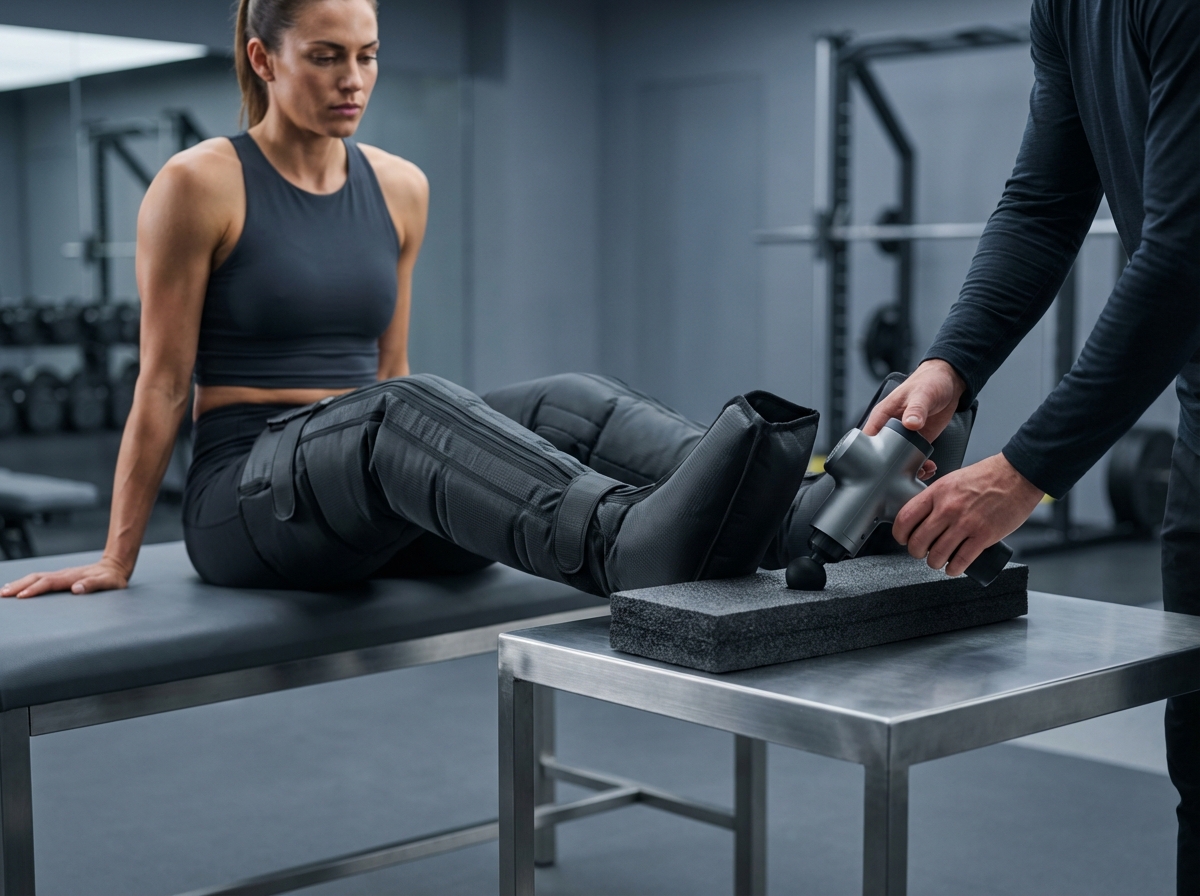
Combining these modalities can provide a more complete recovery. You might use a massage gun for five to ten minutes to loosen up specific tight spots. Following this with a 20-minute session in compression boots helps flush out the area and reduce overall swelling. This sequence is particularly effective for acute DOMS. The gun addresses the mechanical stiffness. The boots handle the circulatory and inflammatory components. This dual approach is common in elite training environments like the Golden State Warriors facility. They use percussive therapy for immediate muscle activation and pneumatic compression for long-term tissue health.
For more information on how these tools compare, you can check this guide on Compression Recovery Boots vs. Massage Guns. It provides additional context on which tool might fit your specific athletic goals. Both devices have a place in a modern recovery toolkit. Your choice should reflect your budget, your primary physical complaints, and how much time you can dedicate to your recovery routine.
Choosing and programming devices for training cycles and travel
Choosing the right recovery tool starts with a clear look at your physical needs and your daily routine. If you struggle with heavy limbs or systemic swelling after high-volume training, compression boots are the primary choice. These systems use pneumatic pressure to move fluid. If your main issue is a specific knot in your hamstring or a tight spot in your calf, a massage gun is more effective. Budget plays a role because massage guns typically cost between $100 and $600. Compression boots are a larger investment that ranges from $300 to $1500. Portability is another factor. A massage gun fits in a small gym bag. Boots require a larger carrying case and a place to sit still for half an hour.
| Feature to Consider | Compression Boot Specs | Massage Gun Specs |
|---|---|---|
| Intensity Metric | Pressure range 40 to 90 mmHg | Amplitude 10 to 16 mm |
| Power Metric | Sequential or gradient patterns | Stall force 30 to 60 pounds |
| Speed/Frequency | Cycle times per limb | 20 to 60 Hz frequency |
| Portability | Bulky with external pumps | Handheld and lightweight |
| Battery Life | 2 to 4 hours typical | 3 to 6 hours typical |
Technical Specifications for Selection
When you look at compression boots, check the chamber count and the pressure range. Systems with more chambers provide a smoother transition of fluid. Look for models that offer an app for custom programming. This allows you to isolate specific areas like the quads if you have a strain. For massage guns, amplitude is the most important number. If the amplitude is less than 10 mm, the device is a vibrator rather than a percussive tool. High stall force is necessary for athletes with dense muscle mass. It prevents the motor from stopping when you apply pressure. Noise levels are also a factor for home use. Many modern guns operate below 60 decibels.
Post-Long-Run Compression Protocol
Use your boots within two hours of finishing a long endurance session. Set the device to sequential mode. This pattern inflates the foot chamber first and then moves up the leg. Keep the pressure between 50 and 70 mmHg. A session should last 20 to 30 minutes. This timing helps clear metabolic byproducts. Research suggests that this approach can significantly improve lactate clearance compared to passive rest. Keep your legs elevated slightly during the session to assist with venous return.
Warm-Up Massage Gun Protocol
A massage gun is an excellent tool for pre-workout preparation. Use a flat or round head attachment. Spend 30 to 60 seconds on each major muscle group. Use a low to moderate speed setting. Do not press hard into the tissue. The goal is to stimulate the mechanoreceptors and increase local blood flow. This can improve your range of motion without the loss of power often seen with static stretching. Focus on the calves, quads, and glutes before a run or a lifting session.
Acute DOMS Combination Protocol
When you have significant delayed onset muscle soreness, combining both tools is effective. Start with the massage gun for 5 to 10 minutes. Use it to target specific tight spots and loosen the fascia. Follow this immediately with a 30-minute compression boot session. The gun breaks up the localized tension. The boots then help flush the area. This two-step process addresses both the mechanical stiffness and the systemic inflammation. It is a common strategy used by professional teams to manage heavy schedules.
Travel and Flight Recovery
Travel often causes fluid retention in the lower legs. Use your compression boots for 20 minutes before heading to the airport. If you have a portable battery-powered model, use them again immediately after landing. This prevents the heavy leg feeling associated with long flights. For road trips, a massage gun is easier to use during rest stops to keep the blood moving in the hamstrings and glutes. These small interventions maintain circulation when you are forced to be sedentary.
Programming Across Training Cycles
Your recovery intensity should match your training load. During heavy microcycles, use the boots daily for 30 minutes. This supports the high volume of work. During a taper or a competition week, reduce the duration to 15 or 20 minutes. Use lower pressure settings to avoid overstimulating the nervous system. Monitor your progress using subjective soreness scales and sleep quality. If you wake up feeling fresh and your readiness metrics are high, your current protocol is working. If you feel lethargic, you might be overusing the devices or using settings that are too aggressive.
Safety and Maintenance Guidelines
Always seek medical clearance if you have a history of deep vein thrombosis or peripheral arterial disease. Do not use a massage gun directly over bony prominences or acute injuries like a grade two muscle tear. Hygiene is vital for shared devices. Wipe down the interior of the boots with a non-bleach disinfectant after every use. Clean the massage gun attachments with alcohol wipes. Store the batteries in a cool place to extend their lifespan. Check the hoses on your compression system for leaks or cracks regularly to ensure consistent pressure delivery.
Frequently Asked Questions
Choosing between compression boots and massage guns
The choice between these two tools depends on your specific recovery needs. Compression boots provide a systemic approach. They cover the entire limb and use pneumatic pressure to move fluid. This makes them ideal for reducing general swelling and flushing metabolic waste after long endurance sessions. Massage guns offer a targeted approach. They use percussive therapy to treat specific muscle knots or trigger points. If you struggle with heavy legs after a marathon, boots are likely better. If you have a specific tight spot in your calf or hamstring, a massage gun is the more efficient tool. Many elite athletes use both to cover all aspects of muscle maintenance.
Speed of soreness reduction
Massage guns provide the fastest relief for localized stiffness. You can see a reduction in muscle stiffness within minutes of use. This makes them perfect for quick sessions between heats or before a workout. Compression boots require more time to be effective. A typical session lasts 20 to 30 minutes. However, the results of boots are more comprehensive for the entire lower body. Studies show that boots can significantly reduce delayed onset muscle soreness in cyclists. While the gun is faster for a single spot, the boots are more effective for total leg recovery in a single sitting.
Using both devices on the same day
You can safely use both tools on the same day. Many professional teams follow a specific sequence for this. They use a massage gun for five to ten minutes to loosen tight fascia and break up adhesions. This is followed by a 20 to 30 minute session in compression boots. The boots then help move the fluids and metabolic byproducts that were released during the percussive massage. This combination addresses both mechanical tightness and systemic circulation. It is a common practice for high-volume training days.
Risks and contraindications
Both devices have specific safety limits. Compression boots should not be used if you have a history of deep vein thrombosis or DVT. The pressure can potentially dislodge a clot. They are also not suitable for people with severe peripheral arterial disease or acute skin infections. Massage guns should never be used directly on bones, joints, or the neck. You must avoid using them on acute injuries like muscle tears or severe bruises. Using a percussive tool on an area with active inflammation can make the injury worse. Always start on the lowest setting to see how your body reacts.
Frequency of recovery sessions
You can use these devices daily if you are training consistently. Most athletes find that one session per day is sufficient. For compression boots, 20 to 30 minutes after your hardest workout is the standard. Massage guns can be used more frequently in shorter bursts. You might use a gun for 60 seconds per muscle group as part of a warm-up. You can then use it again in the evening for maintenance. Consistency matters more than session length. Using the tools for shorter periods every day is often better than one long session once a week.
Injury prevention capabilities
These tools do not prevent injury directly. They work by improving the environment for recovery. By increasing range of motion and reducing stiffness, they help you maintain better form during exercise. Better form reduces the risk of overuse injuries. Compression boots are particularly helpful for conditions like shin splints. Daily 25-minute sessions have been shown to speed up healing for shin pain by managing local edema and improving blood flow to the lower leg tissues.
Immediate performance versus recovery
Massage guns are excellent for immediate performance gains. Using a gun before a workout can improve your range of motion without decreasing muscle strength. This is a significant advantage over static stretching. Compression boots are almost exclusively for recovery. While some studies suggest they might improve muscle oxygenation during exercise, their primary value is post-workout. They help you return to your baseline faster so you can perform better in your next training session. They are a tool for readiness rather than an immediate power booster.
Recommended settings for beginners
Beginners should always start with the lowest possible intensity. For compression boots, a pressure of 40 mmHg is a safe starting point. You can gradually increase this as you get used to the sensation. Most athletic boots go up to 90 or 100 mmHg. For massage guns, start with a frequency of 20 to 30 Hz. Use the dampener or large ball attachment first. These attachments are softer and cover more surface area. Avoid the pointed “bullet” attachments until you are familiar with how your muscles respond to percussion.
Choosing based on your budget
Budget is a major factor for most athletes. Massage guns are generally more affordable. You can find high-quality models between $100 and $600. They are also very portable and fit in a gym bag. Compression boots are a larger investment. Prices typically range from $300 to $1500. While they cost more, they provide a passive recovery experience where you can sit and relax. If you have a limited budget, a massage gun offers great value for targeted work. If you have more to spend and prioritize systemic recovery, the boots are worth the investment.
Scientific consensus and professional use
There is a growing body of evidence supporting both technologies. The National Institutes of Health has published studies showing the benefits of percussive therapy for strength recovery. Professional teams like the Golden State Warriors and elite marathoners use these tools as standard parts of their kits. While some researchers call for more long-term studies, the acute benefits for pain perception and blood flow are well documented. Most experts agree that these tools are effective supplements to sleep and nutrition.
Deep Vein Thrombosis and medical safety
The risk of DVT is the most serious concern with compression boots. If you have a blood clot in your leg, the squeezing action can push that clot toward your lungs. This is a life-threatening condition called a pulmonary embolism. If you have unexplained leg pain, swelling, or redness, do not use compression boots. You should consult a clinician before starting any pneumatic compression program if you have heart disease or circulation issues. Safety must always come before recovery gains.
Dynamic sequential versus static compression
It is important to understand the difference between recovery boots and standard compression socks. Static compression provides a constant squeeze. Dynamic sequential compression uses chambers that inflate one by one. This starts at the foot and moves up toward the hip. This “milking” action is much more effective at moving fluid than static pressure. Research indicates that dynamic boots lead to significantly faster lactate clearance compared to passive rest. The movement of the pressure is what makes the technology work.
When to stop using a device
You should stop your session immediately if you feel sharp pain or numbness. Recovery tools should feel intense but never painful. If your toes turn blue or feel cold in the boots, the pressure is too high. If a massage gun causes skin bruising or a “pins and needles” sensation, you are applying too much force. It is also wise to stop if you have a fever or an active infection. Your body needs its resources to fight the illness rather than processing the effects of a deep tissue massage.
For more detailed information on specific protocols, you can read our guide on choosing the right recovery tool for your sport. Always remember that these devices are meant to support a healthy lifestyle. They work best when you are also staying hydrated and getting enough rest.
Results and final recommendations
Choosing the right recovery tool requires a clear understanding of your physical state and your goals for the day. Compression boots and massage guns serve different purposes. They are not interchangeable. Boots provide a systemic approach. They use pneumatic pressure to move fluid through the entire limb. This process mimics natural muscle contractions. It helps push blood and lymph toward the heart. This is why boots are the standard for reducing swelling and clearing metabolic waste after long endurance efforts. Massage guns offer a targeted approach. They use percussive therapy to hit specific muscle knots. This mechanical impulse affects muscle spindles. It reduces stiffness in a localized area. You should choose your tool based on whether you feel general heaviness or specific tightness.
Core Differences in Outcomes
The data shows distinct benefits for each device. Compression boots are highly effective for Delayed Onset Muscle Soreness and clearing metabolic waste, making them a top choice for high-volume training phases. Massage guns excel at improving flexibility and reducing immediate stiffness, offering superior results for preparing a specific muscle for movement or releasing a stubborn trigger point. While boots are better for systemic recovery, guns are superior for targeted mechanical work.
Decision Matrix for Athletes
Use this guide to select your tool based on your current symptoms. If you have heavy legs after a marathon or a long ride, use compression boots. The graduated pressure helps with lymphatic drainage. If you have a specific “knot” in your calf or a tight IT band, use a massage gun. The percussive force breaks down adhesions better than a boot can. For athletes on a budget, a massage gun is the more accessible entry point. It usually costs between $100 and $600. Compression boots are a larger investment. They typically range from $300 to $1500. If you can afford both, a hybrid approach is the most effective strategy for elite performance.
Immediate Post-Event Protocol
After a major competition or a long training session, your priority is managing inflammation. Start with compression boots as soon as possible. Set the pressure between 40 and 90 mmHg. Run a sequential cycle for 20 to 30 minutes. This helps prevent fluid from pooling in the lower extremities. Avoid using a massage gun on highly inflamed or “angry” muscles immediately after a race. Wait at least a few hours or until the next day to use a gun on specific sore spots. This prevents further irritation of the muscle fibers while they are in an acute state of repair.
In-Season Maintenance Plan
During your regular training weeks, use these tools to stay ahead of fatigue. Use a massage gun for 30 to 60 seconds on each major muscle group before your workout. This increases blood flow and readies the nervous system. After your hardest sessions of the week, use compression boots for 25 minutes. This has been shown to speed up healing for conditions like shin splints. On recovery days, you can combine them. Use the massage gun for 5 to 10 minutes to address specific tension. Follow this with a 20-minute boot session to flush the entire system. This combination addresses both mechanical tightness and systemic fluid retention.
Travel Recovery Strategy
Travel can cause significant limb swelling and stiffness. If you are flying or driving for long periods, use your compression boots before you leave. Use them again as soon as you arrive at your destination. This helps manage the “heavy leg” feeling caused by cabin pressure and inactivity. A massage gun is your best friend during the trip. Its portability allows you to use it in a hotel room or at the venue. Use it to keep your muscles supple during the transition. If you must choose one for a trip, the massage gun wins on convenience. If you are traveling for a peak event, the boots are worth the extra luggage space.
Safety and Efficacy Tracking
Safety must come first. Do not use compression boots if you have a history of deep vein thrombosis or peripheral arterial disease. Avoid them if you have acute skin infections or open wounds. Do not use massage guns directly over bones, nerves, or the neck. If you feel sharp pain, stop immediately. To see if your gear is working, track your metrics. Monitor your subjective soreness on a scale of 1 to 10. Watch your resting heart rate and sleep quality. If your “readiness” scores on your wearable devices improve after using these tools, your protocol is working. If you have persistent pain that does not resolve with these tools, consult a sports clinician. Professional guidance is necessary for chronic injuries or structural issues.
Investing in Quality Gear
When buying a massage gun, look for a stall force that matches your muscle mass. A higher stall force allows for deeper tissue work without the motor stopping. Ensure the amplitude is at least 10 to 16 millimeters. Anything less is just vibration and will not provide true percussive benefits. For compression boots, look for systems with overlapping chambers. This ensures there are no gaps in pressure as the cycle moves up your leg. Battery life is also a key factor for both devices if you plan to use them at the track or on the road. High-quality tools are an investment in your longevity as an athlete. They provide the consistent recovery needed to maintain a high training volume over many years.
Sources
- Compression Recovery Boots vs. Massage Guns: Which is Better for … — Q: Do compression boots help with shin splints? A: Yes! Studies show 32% faster healing with daily 25-min sessions.
- Massage Gun Versus Recovery Boots: What is the Difference? — Both tools aid in muscle recovery but differ in their approach; while recovery boots enhance overall circulation using compression technology, …
- Compression Boots vs. Massage: Which Is Better for Recovery? — Conclusion: Overall, both compression boots and massage can be effective in aiding recovery and promoting overall wellness. It's important to …
- Compression Boots vs. Massage Guns: Which Is Better for Marathon … — Recovery compression boots are a higher initial investment but offer long-term recovery benefits, while massage guns tend to be more affordable.
- The Recovery Revolution: Compression Boots vs. Massage Guns vs … — Compression Boots: · Very expensive; bulky and less portable. ; Massage Guns: · Requires active self-application (or a partner); can be intense; …
- Massage Guns and Compression Boots: Recovery That Improves … — Premium recovery tools like massage guns and compression boots, your body can recover substantially quicker unlocking your full potential.
- Fundamentals or Icing on Top of the Cake? A Narrative Review of … — Similar to compression garments, the majority of studies on recovery boots or sleeves report acute benefits to perceived muscle soreness, …
- New Study Shows How Therabody's RecoveryAir Pneumatic … — Researchers of a new study put Therabody's Recovery Air 3 PRO pneumatic compression boots to the test to see if they enhanced recovery and subsequent exercise …
- The Effects of Massage Guns on Performance and Recovery – NIH — In the recovery-related outcomes, massage guns were shown to be cost-effective instruments for stiffness reduction, range of motion and strength …
Legal Disclaimers & Brand Notices
The information provided in this article is for informational and educational purposes only and does not constitute professional medical advice, diagnosis, or treatment. Always seek the advice of a physician or other qualified health provider with any questions you may have regarding a medical condition or the suitability of specific recovery protocols. This is especially critical for individuals with a history of deep vein thrombosis (DVT), peripheral arterial disease, or other circulatory concerns.
All product names, logos, and brands mentioned in this text are the property of their respective owners. All company, product, and service names used in this article are for identification purposes only. Use of these names, logos, and brands does not imply endorsement, affiliation, or sponsorship.